
Poonch Covers: Seals, Kahuta, the Uri Line, Sialkot and the End of the State Post
Poonch’s circular seal and square obliterator, the Kahuta exchange, the Uri line to the Kashmir Valley, the Sialkot office, combination stationery and the transfer of January 1895.
Updated August 4, 2026
In this article
Two local obliterators
Staal describes a circular bilingual seal of about 30 mm, used until July 1887, and from August 1887 a 17 mm device of three concentric squares round a dot. The measurements matter, because similar forged devices are recorded; but a ruler alone is not enough to authenticate a strike.[1]
The circular seal has fixed office wording and the design year Samvat 1933. Its invocation to Shri Raghunath is religious, not the name of a maker or postmaster. Calling it undated means only that it does not give the day each letter was cancelled.[1]
Why the seal may miss the stamp
A state seal and a manuscript mark could do different jobs on one cover. Douie saw that the local word for “stamped” was sometimes written across the stamp, and the postal official could then apply the large circular seal elsewhere on the envelope. A stamp without the seal on it is not, for that reason alone, unused or a later addition.[5]
The reverse is just as important: concentric-square and Kashmir-style circular cancellations were also imitated on forged stamps. Douie described a fairly deceptive one-anna imitation on laid bâtonné and thin quadrille papers, not only crude copies on thick coloured paper. Judge the design, paper, handwriting and the stamp’s place on the whole cover together; a familiar-looking mark settles nothing.[5]
Kahuta: the exchange with British India
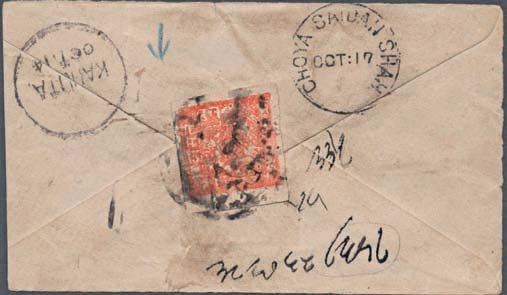
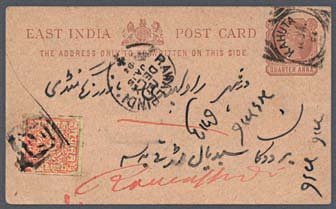
A combination cover to Amritsar illustrated by Staal has a Poonch half anna, cancelled by the local square device, and Indian half-anna stationery cancelled at Kahuta on 2 March 1889. Kahuta was in British India, outside Poonch. Staal cites Godfrey’s written statement that Poonch had a branch there, while noting that no separate Poonch handstamp of that office is known. The Imperial Kahuta cancellation and the reported Poonch branch are different things.[1]
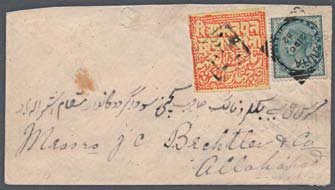
The Amritsar cover is Staal’s figure 3, a half-anna definitive (SG 12), not a two-annas franking. It is a different cover from the four-annas cover to Allahabad shown below.[1]
The valley route and Sialkot
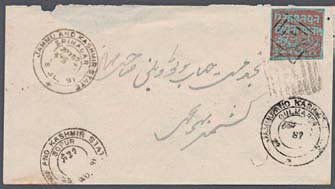
According to the historical account Staal quotes, the Uri line opened in 1887, linking the Kashmir Valley and Poonch over the Haji Pir Pass three times a week. Covers to Gulmarg bear Poonch stamps with Jammu and Kashmir grid and dated transit marks. They show the difference between a cancellation that actually obliterates a Poonch stamp and a transit mark that merely touches it.[1]
For the route through the plains, Staal illustrates a Poonch–Jammu cover of 1888 via Kahuta and Sialkot, and one of 1884 with the Dogri mark of the Sialkot office and a postage-due seal. He concludes that Poonch also used the Jammu and Kashmir office at Sialkot. Where other covers have missing or illegible dates the question stays open, and his suggestions about delays and weights are not treated here as proven rates.[1]
Indian stationery with a Poonch stamp
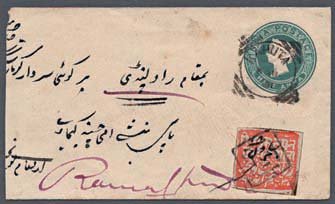
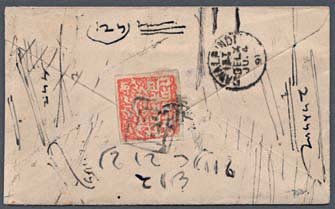
British Indian postal stationery could carry a Poonch stamp for the local stage and its own printed stamp for the Imperial stage beyond. The postcard and envelopes below are combination uses, not a Poonch stationery issue. Their cancellations, destinations and dates belong to each object; they do not add up to a tariff by weight.
A cover catalogued in 1891 shows a boxed TOO LATE mark with the Kahuta exchange marks. It records how the letter was treated; it does not tell us which departure was missed, how long the delay was or whether a fee was charged.
The end of the state post
An official letter of 8 December 1894, reprinted in The Philatelic Journal of India in January 1897, lists Poonch among the administrations already taken over by the Imperial Post or due to pass to it on 1 January 1895. Local stamps were to cease postal use when Imperial offices had been opened throughout each state. The letter groups the states together and gives Poonch no exact day.[10]
Staal’s postal period of 1876–1894 and Evans’s account of use to the end of 1894 are summaries by those writers. The official letter supports a transition at the end of 1894 or on 1 January 1895 without fixing Poonch’s last postal day. Godfrey’s mistaken 1885 in his April article and the museum article’s 1888 are not allowed to override the dated covers of the 1890s.[1][4][13][3]
O’Shea, writing in January 1898, is more specific: he places Poonch’s absorption into the Imperial system in January 1895, and says the native office closed and its stamps ceased to be current shortly after. That is a later account, not the transfer order itself, but it qualifies the summaries that end the stamp period in 1894. Absorption and the end of the stamps’ validity need not be the same day.[12]
Reading a Poonch cover
On a cover, identify the Poonch obliterator before reading any Indian or Jammu and Kashmir transit mark. Kahuta and Sialkot were two different exchanges with the plains; the Uri line opened the valley connection. Staal separates an Imperial transit strike that overlaps a Poonch stamp from a Jammu and Kashmir obliterator actually used on it. Keep the date in the design, the date of the cover and any modern description apart rather than merging them into one issue date.[1][2][3]
What is still to be found
The name of the Srinagar cutter in Godfrey’s accounts, a signed design, commission or payment record, the original proof book, and a mineral test of the stone die are still to be found. So are the name of any paper mill, supplier or ink maker, a watermark census, the exact day Poonch passed to the Imperial post and the last day its stamps were valid. The large-oval half anna and the black one-anna and two-annas officials have no illustration here.
Sources
- [1] Frits Staal, Poonch: Notes on Design and Postal History, The London Philatelist 108, March 1999, pp.44–57.
- [2] Frits Staal, The First Three Issues of Poonch, The London Philatelist 111, March 2002, pp.61–70.
- [3] Geoffrey Eibl-Kaye, Poonch Handstruck Stamp Dies, The London Philatelist 114, March 2005, p.45; One Pice Poonch Handstruck Stamp Die: A Correction, LP120, July–August 2011, p.224.
- [4] E. B. Evans, “The Stamps of some of the Native States of India: Poonch—continued”, Gibbons Stamp Weekly, 27 March 1909, pp.218–219.
- [5] F. M. Douie, “The Stamps of Poonch”, The Philatelic Journal of India, vol.XXXVI, no.6, June 1932, pp.[64]–70.
- [10] The Philatelic Journal of India I(1), January 1897, Notes and Extracts, p.15.
- [12] F. B. O’Shea, “Poonch Native States”, The Philatelic Journal of India, vol.II, January 1898, pp.9–10.
- [13] Captain S. H. Godfrey, “Preliminary Notes on the Stamps of Poonch”, The Philatelic Journal of India, vol.III, no.4, April 1899, pp.155–157.
Notes 0
Add what you know: a cover or stamp in your collection, a date or source, a correction or a question.
No notes yet.
Sign in to add a note.
Notes show straight away. Keep them kind and about the article; anyone can report one that isn't. House rules
