
Poonch: the Mountain State and Its Handstruck Stamps
Poonch, beyond the Pir Panjal, ran its own post from 1876 to January 1895 with stamps struck by hand from single dies, and reached the plains through Kahuta and Sialkot.
Updated September 22, 2026
In this article
The state behind the stamp
Historical Poonch lay south-west of the Pir Panjal range, with its capital at Poonch. It was ruled by a Dogra house within the larger state of Jammu and Kashmir. Its links to the Punjab plains and to the Kashmir Valley followed very different country, and its old postal routes say nothing about present-day borders.
Begin with the hills
Frits Staal uses geography to explain the covers. The Pir Panjal separates Poonch from the Kashmir Valley, and a route to the Punjab plains could be easier than a journey within the mountain state itself. Poonch’s stamps are best studied alongside Jammu and Kashmir and British Indian markings, keeping each administration’s part clear.[1]
The rulers
Moti Singh’s rule covered most of the stamp period. Godfrey names Baldeo Singh, also written Buldeo Singh, as Moti Singh’s son and successor; O’Shea, writing in January 1898, placed the succession about five years earlier, an approximate memory rather than an exact accession date. A ruler’s reign and the dates a stamp was issued or valid are different kinds of evidence.[13][12][1]
| Reign | Ruler | Note |
|---|---|---|
| 1852–1892 | Raja Moti Singh | Staal places nearly all the stamp period of 1876–1894 in his rule |
| From about 1892 | Raja Baldeo Singh (Buldeo Singh) | Moti Singh’s son and successor; allowed the striking of stamps to be watched and authorised the disposal of the dies |
Chronology
| Date | Event |
|---|---|
| 1876 | First Poonch stamp design, six pies, Samvat 1933 |
| 1877 and 1879 | Two half-anna designs, Samvat 1934 and 1936 |
| 1880 | Two-panel definitive design, Samvat 1937: half, one, two and four annas |
| 1887 | Uri line to the Kashmir Valley reported open; square obliterator in use from August |
| Later definitive period | Small quarter-anna design, inscribed one pie for one pice |
| February 1885 | The Philatelic Record describes four values sent by the postmaster |
| 8 December 1894 | Official letter lists Poonch among states taken over or due to pass to the Imperial Post on 1 January 1895 |
| January 1895 | Absorption into the Imperial system, according to O’Shea; the native stamps ceased to be current shortly after |
| January 1898 | O’Shea watches the one-anna and four-anna values still being struck for fiscal use |
| 7 July 1899 | The five later dies defaced at Simla, with impressions taken before and after |
Recording a Poonch stamp
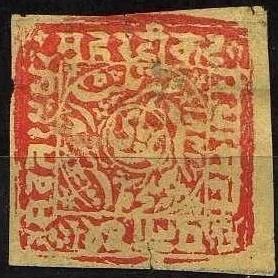
For a Poonch stamp, record the value, the design, the Samvat year, the size, the paper, the ink and the cancellation as separate observations. Staal’s comparison of the early designs uses the size of the oval, the number of rosettes and the inscription; the shade of red alone does not tell the 1876, 1877 and 1879 types apart. For the later dies, separate impressions of the postal period from strikes made before or after the defacement of July 1899.[1][2][3]
The chapters that follow take the designs and their dates, the way the stamps were struck and the dies that survive, and the covers and routes, from the local seals to Kahuta, the Uri line and Sialkot.
The stamps
The issues and their values, from the research checklist. Official stamps, and the papers, shades and sheet arrangements of each issue, are not listed.
| Period | Issue | Values |
|---|---|---|
| 1876 | Early circular-inscription design | 6 pies (= ½ anna) |
| 1877 | Small-oval half anna, Samvat 1934 | ½ anna |
| 1879 | Large-oval half anna, Samvat 1936 | ½ anna |
| 1880 onwards | Two-panel definitive, Samvat 1937 | ½ anna, 1 anna, 2 annas, 4 annas |
| Later definitive period | Small quarter-anna design | ¼ anna |
Sources
- [1] Frits Staal, Poonch: Notes on Design and Postal History, The London Philatelist 108, March 1999, pp.44–57.
- [2] Frits Staal, The First Three Issues of Poonch, The London Philatelist 111, March 2002, pp.61–70.
- [3] Geoffrey Eibl-Kaye, Poonch Handstruck Stamp Dies, The London Philatelist 114, March 2005, p.45; One Pice Poonch Handstruck Stamp Die: A Correction, LP120, July–August 2011, p.224.
- [12] F. B. O’Shea, “Poonch Native States”, The Philatelic Journal of India, vol.II, January 1898, pp.9–10.
- [13] Captain S. H. Godfrey, “Preliminary Notes on the Stamps of Poonch”, The Philatelic Journal of India, vol.III, no.4, April 1899, pp.155–157.
- Evert Klaseboer, online Indian States catalogue: Poonch, visible stamp illustrations and identification notes (consulted 31 October 2026).
- StampWorld, Poonch, circular first design and definitive families.
Notes 0
Add what you know: a cover or stamp in your collection, a date or source, a correction or a question.
No notes yet.
Sign in to add a note.
Notes show straight away. Keep them kind and about the article; anyone can report one that isn't. House rules
