
Struck by Hand: Poonch’s Sheets, Papers and the Surviving Dies
How Poonch stamps were struck one at a time on bazaar paper, what the papers can and cannot tell us, and the brass and stone dies defaced at Simla on 7 July 1899.
Updated October 23, 2026
In this article
A sheet made one impression at a time
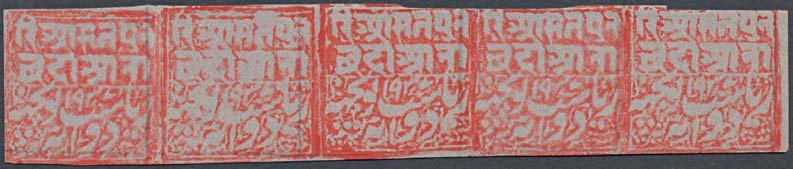
Poonch stamps were struck singly from hand-held dies. A pair with one stamp upside down records how separate impressions were placed on the sheet; it is not an inverted subject fixed in a printing plate. Sideways and opposite-facing impressions are especially common on the small quarter anna.
Spacing is evidence too, but only while the multiple survives. Evans described both widely and closely spaced half-anna impressions on laid bâtonné paper, and a vertical tête-bêche pair of the wide form in the Tapling collection. A single stamp cannot tell us about its lost neighbour, the layout of the sheet or a fixed pane size.
Watching the stamps being struck
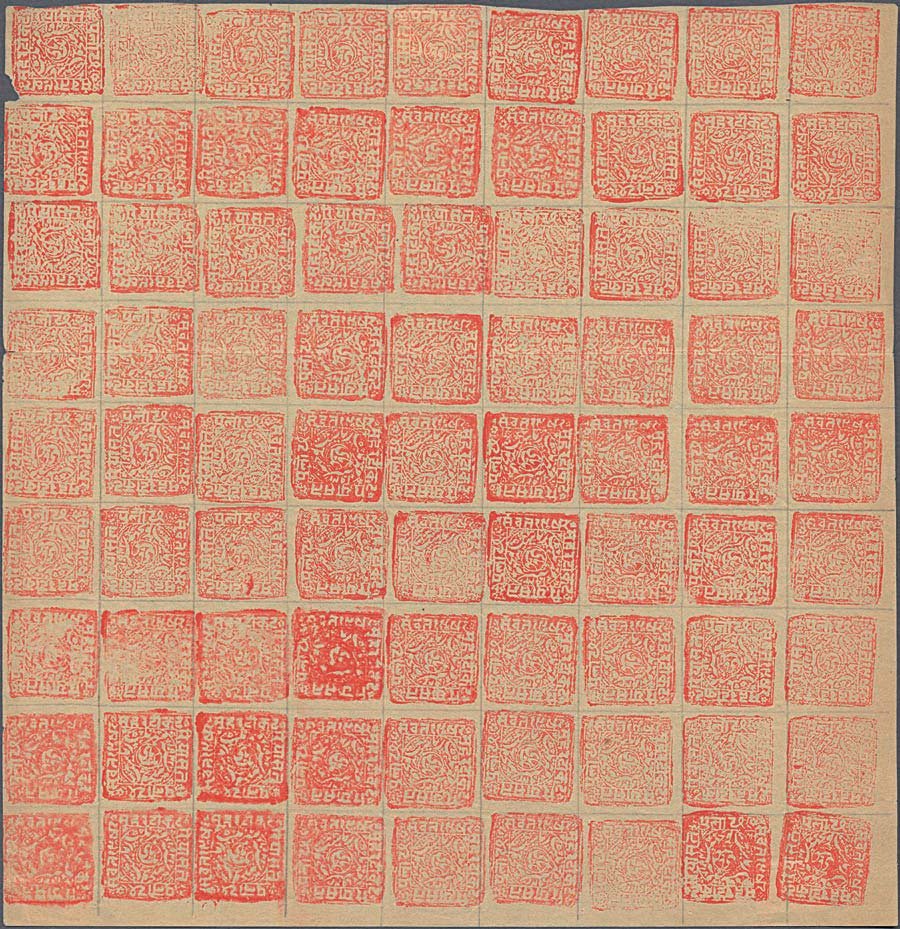
Godfrey describes the Postal Department striking stamps as they were needed, on paper bought in the local bazaar. F. B. O’Shea, writing in January 1898, describes what he saw: an operator, not named, held a brass die in a handle, kept the red colour on his left palm, and struck damp paper laid on a cloth pad. He was watching the one-anna and four-anna stamps still being struck for revenue use, so his account should not be stretched to every earlier postal issue or to the stone quarter-anna die.[12][13]
The sheet arrangements Godfrey recorded vary by value and by the size of paper to hand: for example, eleven rows of nine quarter annas and nine rows of ten half annas, with other arrangements for the higher values. These are handstruck sheets, not fixed plates, so a nine-by-nine sheet of quarter annas fits the same method and is not a new issue.[14]
The Postal Department is the office that made the stamps, in Godfrey’s account. No individual printer, press, paper mill or ink maker is named, and the operator O’Shea watched is not identified as the designer or die-cutter.[13][12]
Papers deserve their own study
Laid and wove papers, coloured papers and tête-bêche arrangements make a much larger specialist field, and Staal deliberately leaves most of it aside. A rare paper should not be assigned from a photograph, nor an old rarity count repeated as a census. Record the texture, mesh, ruling, thickness, any watermark-like effect and the provenance from the stamp itself.[1]
The papers bought locally included wove, laid, ribbed, bâtonné and coloured writing papers. Godfrey calls them chiefly European; O’Shea also records native paper. Neither names a mill or supplier. Evans’s insistence on large margins and multiples is a good discipline, not licence to name a paper from the face of one scan.[13][12][4]
The early paper classifications were disputed. In 1899 Godfrey doubted the thick papers because neither he nor Masson had found used examples. Evans later described material the postmaster had sent in 1885, and F. M. Douie tested further varieties against covers. These are conclusions of different dates from different evidence, not a reason to erase all thick-paper stamps, nor to assume that every recorded paper and value was issued for postage.[16][18][5]
There is no complete classification of Poonch watermarks, nor proof that none exist. Laid or bâtonné ruling and the impressed words Under Quarter Tola must not be called watermarks without examination in transmitted light. Stamps cut from sheets also tell us nothing about any perforating or rouletting machine.[14][4][5]
Paper is not a postal tariff
Some papers are easier to classify in blocks than singly. Evans distinguished note papers by the number of fine lines between the stronger bâtonné lines, but refused to separate certain varieties without a block or very large margins. He also warned that lavender paper can fade and discolour. A colour name and a few lines in a small image are not enough to assign a specialist paper.
Douie recorded sheets bearing the words Under Quarter Tola and linked particular paper supplies with dated covers. Those words tell us about the paper the stamp was struck on. Without a matching postal regulation they are not the state’s weight step for letters, nor a rate printed as part of the design.[5]
His sequence of coloured papers rests mostly on covers with the half anna and quarter anna; he says he had less evidence for the higher values. His usual colour assignments and his suggested late shortages are a research interpretation of their time, not proof that every value appeared on every paper, or that an unusual combination was used postally.[5]
The surviving dies: stone, brass and a correction
Geoffrey Eibl-Kaye illustrated five later Poonch dies and an obliterator held by the Royal Philatelic Society London museum. The four higher-value dies are brass. In 2005 he called the one-pice die a woodcut; in 2011, after re-examining it, he withdrew that and described very dark green material of the quartz family, fixed to its holder with red sealing wax. Godfrey had called the quarter-anna material bloodstone; descriptions of it as jade-like record its appearance, not a mineral test.[14][3]
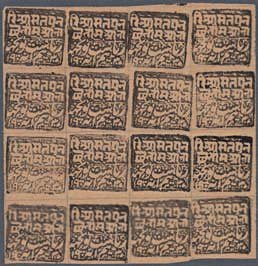
The five later dies were defaced on 7 July 1899. The meeting record distinguishes lines filed into the brass from two chipped edges on the quarter-anna stone; Staal describes crossed scratches on the brass dies and nicks on the sides of the stone. Impressions were taken before and after defacement. A marked impression shows a later state of the die; an unmarked one need not be from the postal period. The three early dies were not in this group, which does not tell us when, or whether, they were destroyed.[17][2][3]
The museum article’s brief summary dating the merger to 1888 conflicts with Staal’s longer chronology and with dated covers of the 1890s, and is not followed here.[2][3]
Postal stamps, later fiscals and study impressions
The end of postal use did not end every use of the dies. The one-anna and four-anna dies stayed in service until July 1898 because those values were still needed for fiscal purposes; the others had gone into safe custody earlier. A late impression from an original die is not automatically a postal-period stamp.
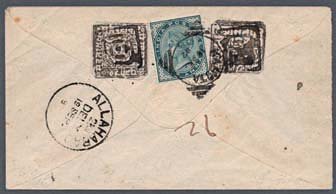
The black impressions taken around the defacement of July 1899 are another category again. The meeting account records black oil-ink impressions before and after defacement. An unmarked black impression might be one of the study strikes taken before defacement rather than an issued official. Paper, provenance and the circumstances of printing remain part of the identification.[17][2]
O’Shea’s account is direct evidence that the one-anna and four-anna values were still being produced for fiscal use in January 1898. It does not extend their postal validity into 1898, and black ink alone does not separate an issued official from a later study strike.[12]
Custody and remainders
A notice of March 1899 reported that Raja Baldeo Singh had entrusted the dies and obliterator to Captain Godfrey, who proposed defacing them and placing them in a museum. It named the Rev. Father Simons as agent for the sale of the remainders. The later meeting report names Sardar Devi Singh, Poonch’s Prime Minister, with Godfrey and C. Stewart-Wilson in the arrangements. These were custody, administration and sale, not the making of the stamps.[11][17]
Godfrey links Moti Singh to the growth of the post and the Kahuta branch. Baldeo Singh made it possible for O’Shea to watch the stamps being struck and later authorised the disposal of the dies. Neither act makes a ruler the designer or printer. Sardar Devi Singh is described as Prime Minister, not postmaster; the postmaster of the 1885 notice and the Deputy Director-General of the 1894 letter are not named.[13][12][17][9][10]
Sources
- [1] Frits Staal, Poonch: Notes on Design and Postal History, The London Philatelist 108, March 1999, pp.44–57.
- [2] Frits Staal, The First Three Issues of Poonch, The London Philatelist 111, March 2002, pp.61–70.
- [3] Geoffrey Eibl-Kaye, Poonch Handstruck Stamp Dies, The London Philatelist 114, March 2005, p.45; One Pice Poonch Handstruck Stamp Die: A Correction, LP120, July–August 2011, p.224.
- [4] E. B. Evans, “The Stamps of some of the Native States of India: Poonch—continued”, Gibbons Stamp Weekly, 27 March 1909, pp.218–219.
- [5] F. M. Douie, “The Stamps of Poonch”, The Philatelic Journal of India, vol.XXXVI, no.6, June 1932, pp.[64]–70.
- [9] The Philatelic Record VII(73), February 1885, Poonch notice, pp.6–7.
- [10] The Philatelic Journal of India I(1), January 1897, Notes and Extracts, p.15.
- [11] The Philatelic Record and Stamp News XXI, March 1899, Items of Interest, p.68.
- [12] F. B. O’Shea, “Poonch Native States”, The Philatelic Journal of India, vol.II, January 1898, pp.9–10.
- [13] Captain S. H. Godfrey, “Preliminary Notes on the Stamps of Poonch”, The Philatelic Journal of India, vol.III, no.4, April 1899, pp.155–157.
- [14] Captain S. H. Godfrey, “Preliminary Notes on the Stamps of Poonch”, The Philatelic Journal of India, vol.III, no.5, May 1899, pp.208–210.
- [16] Captain S. H. Godfrey, “Further Notes on Poonch Stamps”, The Philatelic Journal of India, vol.III, no.9, September 1899, pp.360–362.
- [17] “Philatelic Society of India”, Stanley Gibbons Monthly Journal, 31 August 1899, p. 54: proceedings of the meeting of 7 July 1899 at Fir Hill, Simla.
- [18] E. B. Evans, “The Stamps of some of the Native States of India: Poonch”, Gibbons Stamp Weekly, 30 January 1909, pp.69–73.
Notes 0
Add what you know: a cover or stamp in your collection, a date or source, a correction or a question.
No notes yet.
Sign in to add a note.
Notes show straight away. Keep them kind and about the article; anyone can report one that isn't. House rules
