
Travancore’s First Conch Stamps of 1888
The one, two and four chuckrams of 1888: Dharmalingam Asari’s brass dies, three versions of the conch, the 1888–89 report’s Stamp Office and its print and sale figures, and the 1887 paper contract.
Updated October 25, 2026
In this article
The first conch stamps
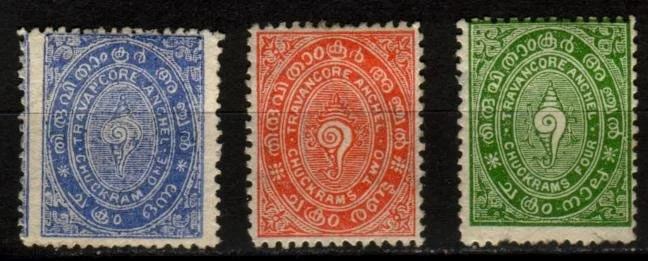
Dawson dates the first stamps to 16 October 1888: one chuckram blue, two chuckrams vermilion and four chuckrams green, with shades. The conch shell was the state emblem. He attributes their design and the engraving of brass dies to Dharmalingam Asari, sent from Orr of Madras, with electrotypes made from the dies. These names and techniques are a specialist account; no production record has confirmed them.[1]
The first paper was handmade laid, with a large arms watermark across the sheet. The two lower values were printed in sheets of 80 and the four chuckrams in sheets of 60, line perforated about 12. A single stamp may show only part of a sheet watermark, so the absence of the whole emblem proves little.[1]
Three versions of the conch
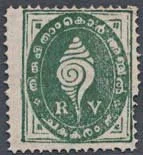
The first stamps were not one drawing with different values. Evans’s account of 1913 distinguishes the comparatively plain one-chuckram conch, with shading inside the shell; the four-chuckram version, without that shading but with side ornaments; and the more elaborate coils and ornaments of the two chuckrams. Dawson later called the conch the sacred emblem of the state; his suggestion that its added “cap” and “wings” echo the ornamented royal conch is an interpretation, not a known instruction to the designer.[28][1]
A reported letter about the local engraver
Sathi Veerachandra Menon’s study of 1998 adds an administrative trail to the story of local production. She describes a letter from the Dewan of 20 May 1888 to the Political Department in Madras about arrangements with Dharmalingam Achary, a local die-cutter and engraver. The study also reports quotations from overseas firms, but no order placed with them. That supports the decision to use local skill; the original letter has not been examined. Achary and Asari are the spellings of the two sources.[29]
The first stamp year in the government accounts
The administration report for 1888–89 gives a contemporary account of the change to stamps. It says one-, two- and four-chuckram stamps and half-chuckram cards were introduced from the third month of the year, Alpasi; the report’s year ran from 14 August 1888 to 14 August 1889. That supports the issue period, but the exact day of 16 October comes from the specialist account.[19]
The report names the Stamp Office as the place where the stamps and cards were printed, and an expenditure note records the making of dies for the new “Unjel labels and cards”. Together they show local production and the preparation of dies. They do not name the designer or engraver, the metal of the dies or electrotyping, so the account naming Dharmalingam Asari and Orr of Madras keeps its own citation.[19]
The annual return gives these figures for the reporting year, which include the months after introduction. They do not measure the first printing, the whole issue or the copies that survive.[19]
| Postal item | Printed | Sold |
|---|---|---|
| 1-chuckram stamp | 517,040 | 367,018 |
| 2-chuckram stamp | 76,640 | 29,347 |
| 4-chuckram stamp | 54,240 | 32,048 |
| ½-chuckram card | 184,746 | 76,607 |
| Total stamps and cards | 832,666 | 505,020 |
The change mattered: the Anchal chapter explains that stamps and cards replaced payment in cash and a separate receipt for every chuckram paid as postage. The legislation chapter names the measure for the better management of the Anchal and the regulation of postage as Regulation I of 1064. The report records that it was passed, but the regulation itself must be read before giving it a legal starting day.[19]
Watermark security began with a paper contract
A published extract of a contract explains why special paper mattered. The agreement of 12 August 1887 between Alexander Cowan & Sons of London and the Travancore government was for a continuous supply of watermarked paper to be printed with stamps, expressly to prevent forgery, and for the dandy rolls and moulds.[11]
Only the opening of the contract survives in the extract; the schedules and the remaining clauses are missing. It does not show who made every later stamp paper, or that a given stamp was printed on paper from this contract. Dawson’s later attribution of the postage papers to Dickinson, and this contract’s naming of Cowan, are kept side by side.[11]
Sources
- [1] L. E. Dawson, “Travancore: The ‘Conch’ Stamps”, The Collectors Club Philatelist, vol. 39, no. 6 (1960), pp. 287–296 and appended table.
- [11] “1887 Agreement for Supply of Special Paper to Travancore State”, IND DAK, June 1987, p. 102, reproduction of the opening of the agreement dated 12 August 1887; editorial introduction unsigned.
- [15] Christoph Gärtner, 17th auction, 7 March 2011, Travancore lots 1635–1640, pp. 103–104.
- [19] Government of Travancore, Report on the Administration of Travancore for the year M.E. 1064, A.D. 1888–89, Trevandrum: Travancore Government Press, 1890.
- [22] Evert Klaseboer, online Indian States catalogue: Travancore.
- [28] [Edward B. Evans], “The Stamps of Some of the Native States of India: Travancore”, Stanley Gibbons Monthly Journal, 31 March 1913, pp. 88–90; 31 May 1913, pp. 152–153; 30 August 1913, p. 233.
- [29] Sathi Veerachandra Menon, “A Story Behind the First Set of Travancore Anchal Stamps”, Ind Dak, October 1998, pp. 178–183.
Notes 0
Add what you know: a cover or stamp in your collection, a date or source, a correction or a question.
No notes yet.
Sign in to add a note.
Notes show straight away. Keep them kind and about the article; anyone can report one that isn't. House rules
