
Travancore Postmarks, Railway Anchal Service and Privileged Mail
Barred cancellations with Malayalam numbers, T.R.A.S. railway markings, post-free palace mail, an intact envelope, and the end of the state post under Travancore-Cochin in 1949–1951.
Updated October 2, 2026
In this article
Early barred cancellations
The earliest cancellation in the survey of 1966 is a circle of 25 mm made of eight thick parallel bars, with no office letter. Later barred devices have a large Malayalam character with a smaller Malayalam number. Broken bars and the number separate the types, and should be read from complete strikes. The meaning of the central character was still uncertain in that survey, and 98 was the highest number recorded; a number should not be turned into an office name without a verified office table.[4]
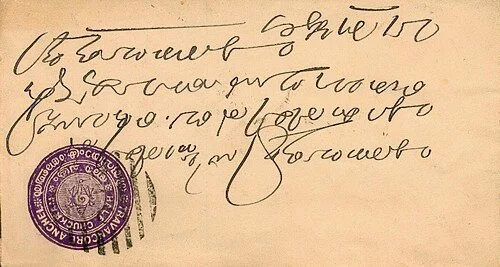
An intact envelope
The Birken envelope has a barred strike tying the purple impressed stamp to the address side. As a complete object it keeps the address and the link between payment and cancellation. Its office, rate and date cannot be read securely from the picture, and a barred strike alone should not be given a numbered office.
Reading T.R.A.S.
Travancore Railway Anchal Service markings combine T.R.A.S., IN or OUT, and a date in a circle. Wells separates straight and curved arrangements and records no set numbers like Cochin’s railway markings. The Travancore and Cochin areas kept their separate railway devices during the union. Keep the whole strike, with its date and direction; Wells’s earliest dates describe the examples then known, not the start of the service.[6]
Post-free privilege was not an issue of stamps
A stampless official cover need not be unpaid. Mooss describes a privilege allowing the Travancore palace, related institutions and specified senders to send articles free through the Anchal. Cochin recognised privileged Travancore mail under a reciprocal arrangement, as Travancore recognised Cochin’s. It was a right attached to the sender and the service, not a missing value.[8]
The cover had to carry wording such as On Sirkar Service or On Palace Service, with the sender’s signature and official designation in the lower left corner; the wording alone does not prove the right. Read it with the signature, office, date and markings.[8]
Union and the end of privileged mail
On 1 July 1949 the United State of Travancore and Cochin began. Travancore’s money had to be converted to the scale of pies and annas, and the surcharged and overprinted stamps of the transition belong to Travancore-Cochin, a new issuer. A political union is not by itself the last day of validity for every stamp or service.[2]
Mooss links the end of the privilege with direct central administration from 1 April 1951. He notes that the notification was dated 5 April, and that there is no evidence the privilege continued in the days between.[8]
Collecting the evidence
A useful study page records the value and unit, design, paper, watermark, perforation, printing features, official overprint and cancellation, in that order. Keep dated covers with the rate schedule that applied at their date, not one undated tariff for 1888–1949. Proofs, cut-outs, court-fee overprints and unused SERVICE cards keep their own status and do not stand in for postal use.[1][7][10]
Still to be found: a complete modern stationery catalogue, a dated tariff from original regulations, the weight steps and exact effective days, a map of postmark offices, a full inventory of late official settings, and the commission, invoice or press record that would settle who designed and printed the stamps of 1931 and 1937.
Sources
- [1] L. E. Dawson, “Travancore: The ‘Conch’ Stamps”, The Collectors Club Philatelist, vol. 39, no. 6 (1960), pp. 287–296 and appended table.
- [2] Frank M. Cowen and J. Devasya, “Travancore-Cochin: Its Postage Stamps and Postal History”, The Collectors Club Philatelist, vol. 32, no. 6 (1953), Part I, pp. 287–302.
- [4] L. E. Dawson, “The Indian Feudatory States—IX: Travancore (part ii)”, The Philatelist, June 1966, pp. 264–266.
- [6] P. Wells, “The Travancore Railway Anchal Service”, KEPEX-72 souvenir, 1972, pp. 3 and 5.
- [7] Government of Travancore, The Travancore Anchal Manual, vol.I: Office Procedure of the Anchal Superintendent’s Office, Government Press, Trivandrum, 1937.
- [8] N. S. Mooss, “Privileged Mails of Travancore–Cochin”, IND DAK, September 1986, p.183.
- [10] P. Wells, Travancore Postal Stationery, India Study Circle typescript checklist, 1966, pp. 11–26.
- Dr. Andreas Birken, Sammlung Birken: addressed Travancore stationery envelope, via Wikimedia Commons.
Notes 0
Add what you know: a cover or stamp in your collection, a date or source, a correction or a question.
No notes yet.
Sign in to add a note.
Notes show straight away. Keep them kind and about the article; anyone can report one that isn't. House rules
