
Travancore Postal Stationery: Envelopes, Reply Cards and Portrait Cards
Circular conch envelopes, reply cards from 1890–91, the FIVE CASH cards, the portrait card with PLUS 2 CASH and the envelope with PLUS 4 CASH, official forms and stationers’ marks.
Updated October 30, 2026
In this article
Stationery has its own chronology
Travancore’s stationery is more than a smaller version of its stamps. The circular envelope designs combine the conch and bilingual inscriptions, while cards change the position of their stamp, their address instructions and the division between message and address. All this is lost when the impressed stamp is cut out.[10]
The early envelopes include one-, two- and four-chuckram values. Paper, flap shape and embossing separate them further: Wells separates envelopes without embossing from those embossed TRAVANCORE GOVT ANCHAL and other words, and his half-chuckram entry of 1913 distinguishes watermarked cream wove from unwatermarked cream laid batonné. A handwritten correction on the checklist changes how the English T relates to a Malayalam character in the first design; compare actual envelopes before using it as a test.[10]
| Family | Wells’s date | Values or wording | Notes |
|---|---|---|---|
| Early conch envelopes | 1889 | 1, 2 and 4 chuckrams | Record paper, flap and embossing |
| Early ordinary conch cards | 16 October 1888 | 8 cash | Type I; several card stocks and later printings |
| Reply cards | July 1892 | 8 cash + 8 cash | A joined pair; the official report puts reply cards in 1890–91 |
| Card provisionals | 1899 | 5 cash on 8 cash; 5 + 5 cash on 8 + 8 cash | Reddish-violet handstamp, then cards printed with five cash |
| Ordinary portrait card | 1941; 1944; eight cash tentatively 1947 | 6 cash; 6 cash plus 2 cash; 8 cash | Types X and XI |
| Green SERVICE portrait card | 1941? and later, undated | 6 cash; 6 cash plus 2 cash; 8 cash | Type S.VI, from the Type X portrait |
Printing, envelope-making and paper
Wells describes the early Type I envelope stamp and the later Type IV and V conch envelopes as lithographed; that applies to those families, not to every Travancore stamp or portrait card. The embossed words on the flap are separate from the coloured stamp. Evans remarks that the envelopes he described were folded and made up before the stamp was printed.[10][28]
Complete envelopes keep trade information a cut-out loses. Wells lists three-chuckram envelopes on pelure paper with an embossed NUZURALLY & GULROODIN, STATIONERS BOMBAY: a stationer’s name on that form, not evidence that the firm printed the stamp or supplied every envelope.[10][28]
Wells also records BRITISH MANUFACTURE with a device on one half-chuckram envelope, a BENGAL PAPER MILLS – CO. LD watermark on the paper of his first wrapper family, and a watermark of the government’s name with a conch supported by elephants on some later three-quarter-chuckram envelopes. He warns that a sheet watermark need not fall on every wrapper or envelope. He places his first wrapper family in October 1896, while the official report of 1895–96 records half-chuckram wrappers in that year; how the two relate is open.[10][28][21]
Reply cards: a joined postal object
The early eight-cash cards carried a conch design and bilingual instructions keeping one side for the address. A reply card was two cards folded face to back, with a line of separation at the fold; the attached half kept the means of reply. Wells records rouletted 7, perforated 10 and perforated 12 forms. A single half cannot tell which separation its missing partner had, so keep pairs intact.[10]
The official record dates reply cards earlier than Wells. The report for M.E. 1066, A.D. 1890–91, says “reply or double cards were introduced” that year, and the 1906 Manual agrees, without describing the design or the separation. July 1892 remains Wells’s date for the family he describes.[20][18]
The same report of 1890–91 abolished the extra two cash charged on an embossed envelope, which it describes as the cost of the envelope over and above the value impressed on it: a selling price for the stationery, not two cash of postage.[20][18]
Wells lists a FIVE CASH handstamp of 1899 on the earlier eight-cash single and reply cards, followed by cards printed with five cash: a handstamped conversion and a new printing are different events. The Manual dates the reduction of the card price from eight to five cash to 1898, not necessarily the same event.[10][18]
The portrait card and the extra two cash
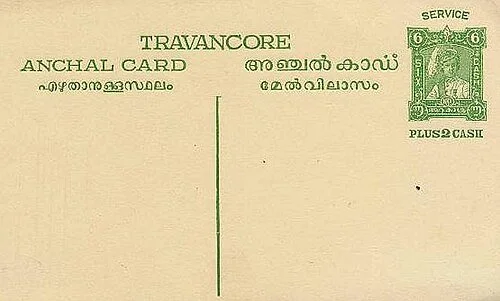
The ordinary portrait card, Wells’s Type X, has Maharaja Sir Bala Rama Varma at the right, Travancore Anchal Card and six-cash wording in two languages to the left, and a vertical dividing line whose position against the lettering helps separate printings. Wells places it in 1941. His group of 1944 adds PLUS 2 CASH below the six-cash design, in varying lengths and type; transcribe both the six cash and the added two cash. A card printed with eight cash followed, tentatively 1947.[10]
The official green card, Type S.VI, is the Type X portrait in green with SERVICE above the stamp, in a six-cash form, with PLUS 2 CASH, and a later eight-cash form with SERVICE almost touching the stamp. Wells marks the early date as uncertain.[10]
An unused card shows the design, not a journey. Its face value, the added two cash and any fee or selling price should be recorded separately, and the whole card kept, since the wording outside the stamp is part of the object.[10]
The portrait envelope added four cash
The portrait envelope is not the portrait card. Wells’s Type VI envelope of 1941 carries the Maharaja’s portrait with a value of three-quarters of a chuckram; his group of 1944 adds PLUS 4 CASH below the stamp, with variations in spacing and embossing. The Type VII envelope of 1945 is printed with one chuckram and changes the English spelling from ANCHEL to ANCHAL.[10]
Official forms without a value
Official stationery includes more than overprinted cards. Wells places unvalued labels, registered labels, cards and envelopes in a separate official group, inscribed On Sirkar Service Only, On Travancore Government Service and Travancore Anchal Service. These are forms, not extra values. He records a Central Stamp Depot registered label with its form number and printing reference, and a pre-addressed registered envelope for the Anchal Superintendent’s office. Copy such references as printed; do not turn a local-era number into a dispatch date. An unused form shows its design and purpose; transmission, free carriage and registration need completed entries and postal marks.[10]
A cut-out and a CF overprint answer different questions
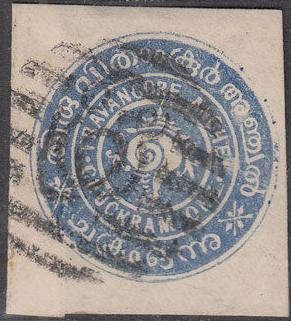
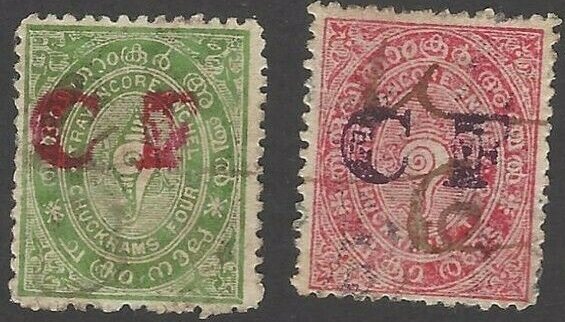
The blue circular piece below is catalogued as cut from a postcard. Its conch and barred cancellation show the design, but the fragment cannot recover the card’s size, instructions, stock or route, and it is not an adhesive stamp. The green four chuckrams and red two chuckrams with large CF overprints were for court fees: the overprint changed their purpose, and they are not postal frankings.[22]
Sources
- [10] P. Wells, Travancore Postal Stationery, India Study Circle typescript checklist, 1966, pp. 11–26.
- [18] V. Nagam Aiya, The Travancore State Manual, vol. III, Trivandrum: Travancore Government Press, 1906, postal chapter pp. 489–493 (information from the Anchal Superintendent, S. Thiraviam Pillay).
- [20] Government of Travancore, Report on the Administration of Travancore for the year M.E. 1066, A.D. 1890–91, Trevandrum: Travancore Government Press, 1892, pp. 109–110.
- [21] Government of Travancore, Report on the Administration of Travancore for the year M.E. 1071, A.D. 1895–96, Trivandrum: Travancore Government Press, 1897, p. 99.
- [22] Evert Klaseboer, online Indian States catalogue: Travancore.
- [28] [Edward B. Evans], “The Stamps of Some of the Native States of India: Travancore”, Stanley Gibbons Monthly Journal, 31 March 1913, pp. 88–90; 31 May 1913, pp. 152–153; 30 August 1913, p. 233.
- Wikimedia Commons, “Travancore postal card”: green SERVICE portrait card, 6 cash plus 2 cash.
Notes 0
Add what you know: a cover or stamp in your collection, a date or source, a correction or a question.
No notes yet.
Sign in to add a note.
Notes show straight away. Keep them kind and about the article; anyone can report one that isn't. House rules
