
Strings, Drums and Flutes: Musical Instruments on Indian Stamps
 An exhibit plan by Alok Jain
updated 24 November 2026
About this exhibit
The Natya Shastra, the old Sanskrit treatise on drama and music, sorts instruments into four families: strings, winds, drums, and solid instruments that sound when struck. India Post's stamps cover all of them, from the veena of the temple and the court to the one-stringed ektara of the wandering singer.
This exhibit follows the instruments themselves through 30 stamps in the catalogue, issued between 1974 and 2020. Musicians appear where a stamp shows them with their instrument in hand: Bismillah Khan with his shehnai, Ali Akbar Khan with his sarod, Ravi Shankar and Vilayat Khan with their sitars. It begins with the veena family, moves through the plucked and bowed strings of the north and south, the drone of the tanpura, the winds and the drums, and ends with the folk instruments of India's wandering minstrels.
The veena, Saraswati's instrument
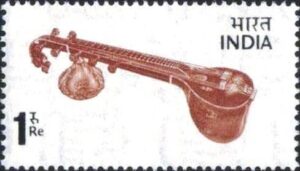
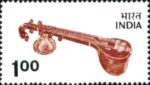
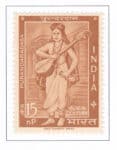
The veena is the instrument held by Saraswati, goddess of learning, and one of the oldest names in Indian music for a stringed instrument. In the south it took its present form at Thanjavur: a large resonator carved from one log of jackfruit wood, a neck with 24 brass frets set in wax, a small gourd under the neck, four playing strings and three drone strings. A ₹1 definitive stamp of 1 October 1974 shows this Saraswati veena.
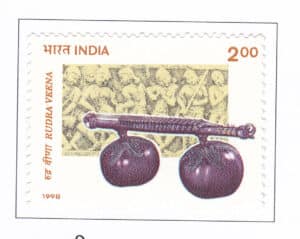
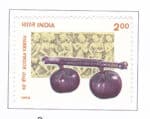
The north kept an older form, the rudra veena or been: a long tube of wood or bamboo resting on two large gourds, with high movable frets. It is the instrument of dhrupad, the oldest surviving style of Hindustani classical music, and grew rare in the twentieth century when the courts that supported its players disappeared. It opens the set of four Musical Instruments stamps issued on 29 December 1998, at ₹2.
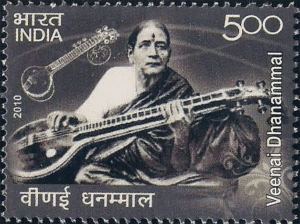
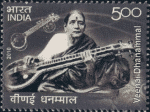
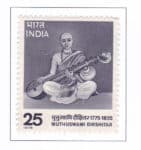
Two Carnatic musicians appear with the veena in their hands: the composer Muthuswami Dikshitar (1775–1835), himself a veena player, on a 25 paise stamp of 18 March 1976, and Veenai Dhanammal (1867–1938) of Madras, whose intimate private recitals were admired by musicians and critics, on a ₹5 stamp of 3 December 2010.
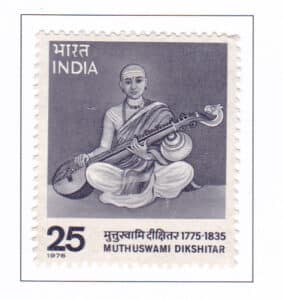
18 March 1976
Birth Bicentenary of Muthuswami Dikshitar (1775-1835)
- Commemorative
- Anniversaries and Jubilees
- Composers
The sarod
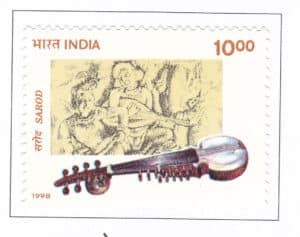
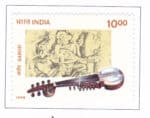
The sarod is a fretless lute of Hindustani music. Its wooden body is covered with goatskin, its fingerboard is a plate of polished metal, and its strings are struck with a plectrum of coconut shell or bone. Because there are no frets, the player can slide smoothly from one note to the next. Scholars trace it to the Afghan rabab, brought to north India by musicians of Afghan descent; in the late nineteenth century players added metal strings and the metal fingerboard. It is the ₹10 stamp of the 1998 set.
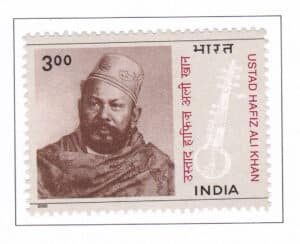
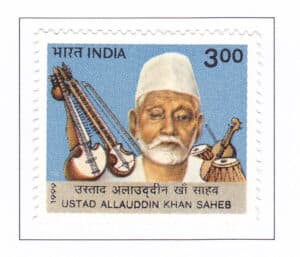
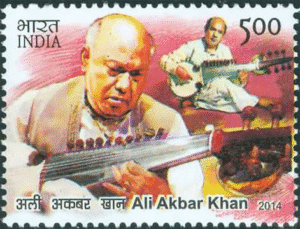
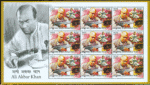
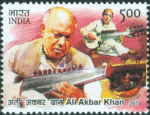
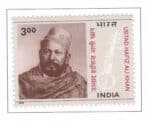
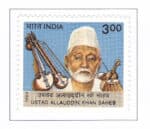
Three masters of the sarod have stamps of their own. Hafiz Ali Khan (1888–1972) of Gwalior, of a Bangash family of sarod players, appears with the outline of a sarod on a ₹3 stamp of 28 December 2000. Ustad Allauddin Khan of Maihar, who played the sarod and many other instruments and rearranged the sarod's strings, is shown on a ₹3 stamp of 19 October 1999 among sitars, a violin and a pair of tabla. His son Ali Akbar Khan (1922–2009), who carried the sarod to audiences in America and Europe, is seen playing it on a ₹5 stamp of 3 September 2014.
The sitar
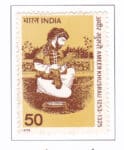
The sitar is the best known Indian instrument abroad. It has a gourd resonator, a long hollow neck of teak or tun wood, and curved movable frets. Six or seven strings are played with a wire plectrum worn on the finger, called a mizrab, while a dozen or more sympathetic strings below them ring in answer. The old story that Amir Khusrau invented it is now doubted; most historians date the instrument to the eighteenth century.
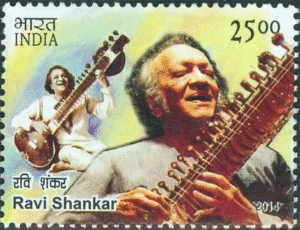
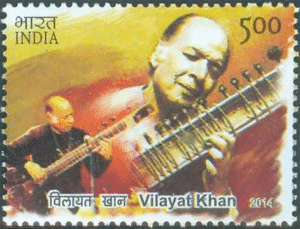
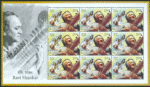
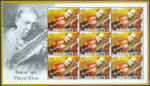
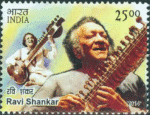
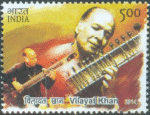
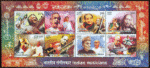
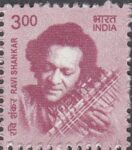
Two of its greatest players appear in the Indian Musicians set of 3 September 2014. Ravi Shankar (1920–2012), a pupil of Allauddin Khan, is on the ₹25 stamp; from the late 1950s his tours, recordings and work with Yehudi Menuhin and George Harrison made the sitar known around the world. Vilayat Khan (1928–2004), son of the sitar and surbahar player Enayat Khan, is on a ₹5 stamp. He shaped a style known as gayaki ang, in which the sitar follows the bends and phrasing of the human voice.
Bowed strings: the sarangi and the violin
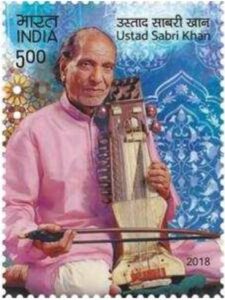
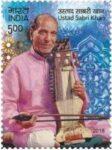
The sarangi is carved from a single block of tun wood, with goatskin over its lower chamber. Its three gut strings are bowed, and stopped not with the fingertips but with the nails and cuticles, while some 35 sympathetic strings ring beneath them. Long the companion of singers, it can follow every slide and shake of the voice. Ustad Sabri Khan (1927–2015) of the Senia Moradabad gharana, who played it in America and Europe and in a duet with Yehudi Menuhin, is shown with his sarangi on a ₹5 stamp of 13 December 2018.
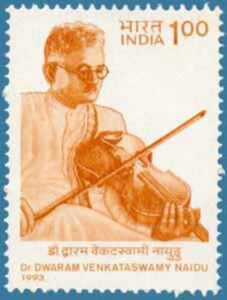
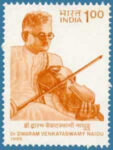
The violin came to South India from Europe and became part of Carnatic music. Tradition credits Baluswami Dikshitar, Muthuswami's younger brother, with first adapting it, though others have claimed the honour too. The Carnatic violinist plays seated, the scroll resting against the foot. Dwaram Venkataswamy Naidu (1893–1964), partly blind from childhood and later principal of the Maharaja's Music College at Vizianagaram, did much to make it a solo concert instrument. His ₹1 stamp of 8 November 1993, his birth centenary, shows him bowing.
The tanpura, the drone behind the song
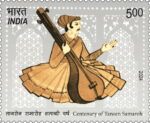
The tanpura, called tambura in the south, plays no tune. Its four strings, usually tuned to the fifth and the tonic, are plucked one after another without stopping, and a broad curved bridge makes each string buzz with overtones. That steady drone is the ground against which a singer or soloist builds a raga. The Miraj tanpura of the north has a gourd body; the Tanjore style of the south is carved from a solid block of wood.
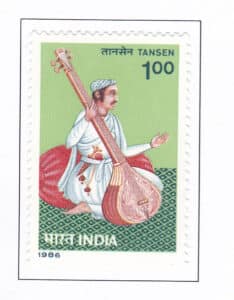
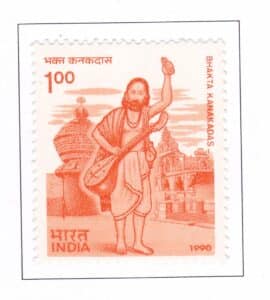
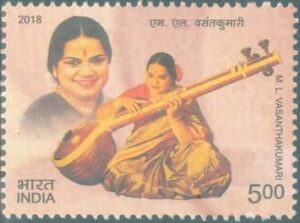
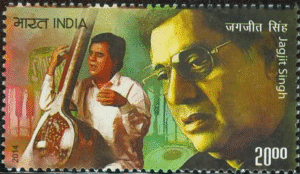
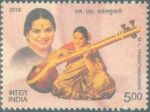
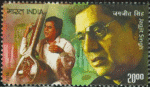
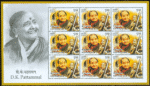
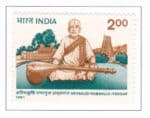
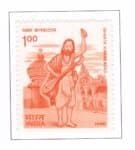
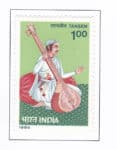
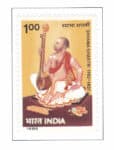
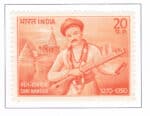
Singers on stamps are often shown with one. Tansen, the great singer at Akbar's court, sits with a tanpura on a ₹1 stamp of 12 December 1986. The Kannada saint-poet Kanakadasa holds a tambura on a ₹1 stamp of 26 December 1990. The Carnatic singer M. L. Vasanthakumari sits beside one on a ₹5 stamp of 3 July 2018, and the ghazal singer Jagjit Singh is seen as a young man playing one on the ₹20 stamp of his pair of 8 February 2014.
Wind instruments: flute, shehnai and nagaswaram
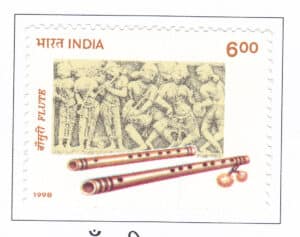
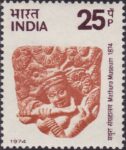
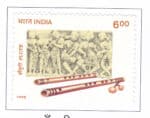
The bansuri, a flute cut from a single piece of bamboo, is played across the lips, with one blowing hole and a row of finger holes. It is the instrument of Krishna, and among the oldest in India. It is the ₹6 stamp of the 1998 set; a woman playing the flute under a flowering tree, carved in red sandstone at Mathura, appears on a 25 paise stamp of 9 October 1974 for the centenary of the Mathura Museum.
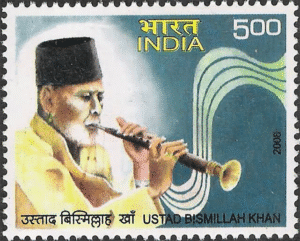
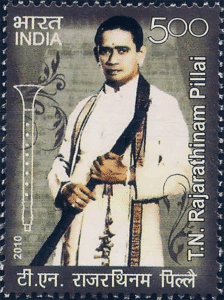
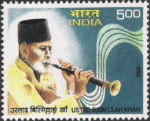
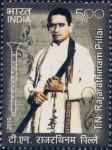
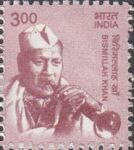
The shehnai and the nagaswaram are double-reed instruments with a widening wooden body and a flared bell, played at weddings and temple festivals, where their sound is held to be auspicious. Bismillah Khan (1916–2006) of Varanasi brought the shehnai from wedding processions to the concert stage, and played it at the Red Fort on 15 August 1947; he received the Bharat Ratna in 2001. His ₹5 stamp of 21 August 2008 shows him playing. The nagaswaram of the south is much longer than the shehnai and is usually played with the tavil drum. T. N. Rajarathinam Pillai (1898–1956), remembered as the emperor of the nagaswaram, holds his on a ₹5 stamp of 3 December 2010.
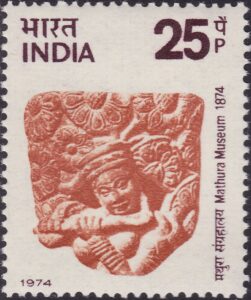
9 October 1974
Centenary of Mathura Museum – Woman Flute Player
- Commemorative
- Anniversaries and Jubilees
- Art
Drums
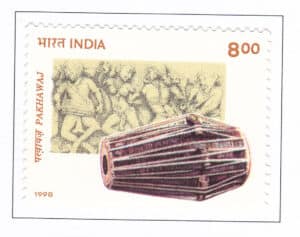
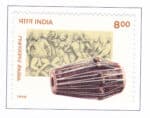
The pakhawaj is a long barrel drum of wood with a skin at each end, laid across the lap of a seated player. Before playing, a paste of wheat dough is pressed onto the bass head to deepen its tone, while the treble head has a permanent black centre. It is the drum of dhrupad, and its strokes and syllables are close to those of the tabla. It is the ₹8 stamp of the 1998 set.
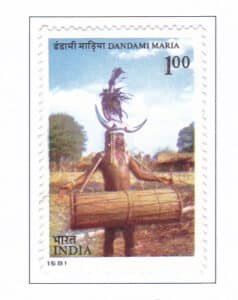
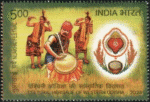
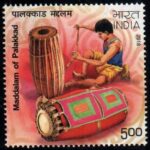
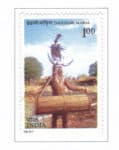
The maddalam of Kerala is carved from a single block of jackfruit wood, and weighs around twenty kilograms; the player stands, with the drum hung at the waist. It is one of the five instruments of the temple ensemble panchavadyam, and is played in Kathakali. The maddalam made around Palakkad, much of it in the village of Peruvemba, is a registered Geographical Indication, and appears on a ₹5 stamp of 31 December 2018. A Dandami Maria man of Bastar, in his bison-horn headdress, beats a long drum slung from his shoulders on a ₹1 stamp of 30 May 1981.
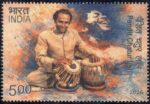
The tabla, the most familiar drum of the north, can be seen beside Allauddin Khan on his stamp. A ₹5 stamp for the tabla player Pandit Chatur Lal, who is credited with bringing the tabla to audiences in the West, was issued on 16 April 2026 for his birth centenary.
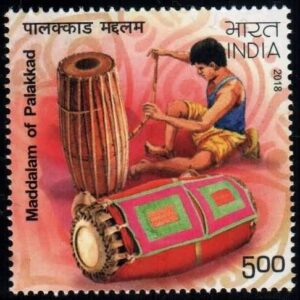
31 December 2018
Geographical Indication Registered Handicraft Products
Maddalam (drum) of Palakkad
- Commemorative
- Crafts
- Musical Instruments
Instruments of the wandering minstrels
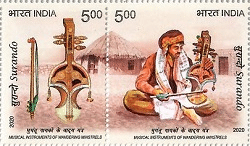
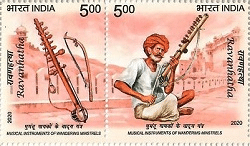
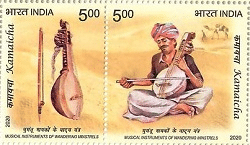
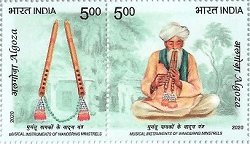
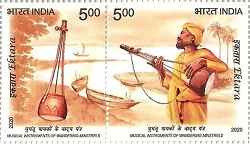
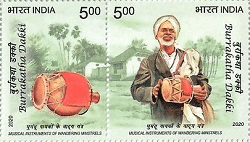
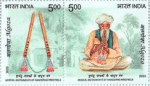
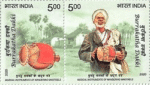
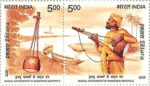
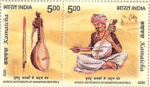
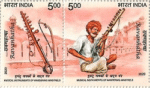
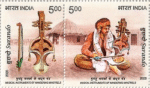
On 25 June 2020 India Post issued a set of stamps, printed in se-tenant pairs, on the musical instruments of wandering minstrels: the singers and storytellers who travel from village to village with songs of gods, heroes and patrons.
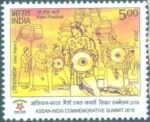
Three are bowed. The surando of Kutch, played by the Fakirani Jat community, has a body cut from one piece of wood. The ravanhatha has a coconut-shell resonator and a bamboo neck; the Bhopas of Rajasthan play it while they sing the epic of the folk deity Pabuji before a painted scroll, the phad. The kamaicha, with a large skin-covered bowl, is the instrument of the Manganiyar singers of western Rajasthan.
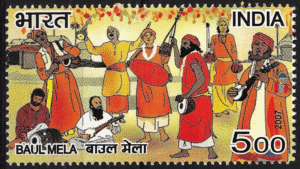
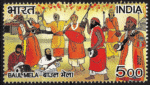
The algoza is a pair of bamboo flutes blown together, one holding a drone while the other plays the tune; the Meos of Alwar play it. The ektara has a single string stretched from a skin-covered resonator along a split bamboo, which the player squeezes to bend the note; it is the companion of the Baul singers of Bengal, who are also seen with their instruments on a ₹5 stamp of 27 February 2007 for the Baul Mela. The burrakatha dakki, a pot-shaped brass drum covered with skin and hung from the neck, keeps time for the burrakatha storytellers of Andhra Pradesh and Telangana.
Sources
India Post's stamp brochures and iStampGallery's issue pages; Wikipedia and its cited sources; the Press Information Bureau; the catalogue pages of The Philatelist.
Stamps in this plan
Comments 0
No comments yet. Be the first to say something kind or useful.
Sign in to join in.
Comments show straight away. Keep them kind and about the exhibit; anyone can report one that isn't. House rules
