
Jind stamps by issue group: values and catalogue numbers, 1874–1950
Every documented Jind issue group from the native lithographs to George VI, with its values, its Stanley Gibbons and StampWorld references and what each group is known for.
Updated November 24, 2026
In this article
This chapter sets out Jind’s issue groups in order, with the references collectors use to find them. A grouped date is a catalogue period, not a first day of issue, and a reference describes a design and value, not every shade, paper, setting or perforation. Where the research has not been able to fix a modern number, the alternatives are given.[1][6][4][33][103]
The native stamps
| Group | Values | References |
|---|---|---|
| First local series, thin wove, imperforate, sheets of 50 (1874 traditionally; documented 1875) | ½, 1, 2, 4, 8 annas | SG J1, J2, J3 or J4, J5, J6a or J7 |
| Azure laid paper, 1876 | ½, 1, 2, 4, 8 annas | SG J8, J9, J10, J11; eight annas J11a, J12 or J13 (Halsey 1896 no. 10) |
| Later designs with the quarter anna, 1882–1885 | ¼, ½, 1, 2, 4, 8 annas | SG J16a or J32; J17, J18 or J19; Halsey no. 12 (one anna); J22 or J30; J24; J25 |
The quarter anna’s two possible numbers, J16a and J32, are both documented; which applies depends on the paper and perforation. Some quarter-anna sheets have 25 subjects and later stones 50, and a suspected 25-subject proof is kept apart. Durbin, fifteenth edition, page 65, lists the brown one anna in both the imperforate and the 1885 perforated groups.[15][88]
Queen Victoria
| Group | Values | StampWorld | Varieties |
|---|---|---|---|
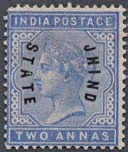
| Curved JHIND STATE, 1885 | ½, 1, 2, 4, 8 annas; 1 rupee | 1–6 | SG 2a (one-anna trial, inverted), SG 3a (two annas inverted), SG 5a (eight annas inverted) |
| Horizontal JEEND STATE, 1885–86 | ½, 1, 2, 4, 8 annas; 1 rupee | 7–12 | |
| Horizontal JHIND STATE, 1886 on | ½, 1, 1½, 2, 3, 4, 6, 8, 12 annas; 1 rupee | 13–27 (red overprints 13–16) | SG 17a (half anna inverted); JEIND on eight annas SG 28a and on one rupee SG 16a |
| Late additions, 1897–1904 | 3 pies; ½, 1 anna; 2, 3, 5 rupees | 28–34 |
Edward VII and George V
| Group | Values | StampWorld |
|---|---|---|
| Edward VII, 1903–1909 (with the 1907 inscription changes) | 3 pies; ½, 1, 2, 2½, 3, 4, 6, 8, 12 annas; 1 rupee | 35–47 |
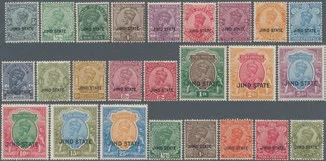
| George V, early JIND STATE setting, 1913 | 3 pies; ½, 1, 2, 3, 6 annas | 48–53 |
| George V, succeeding setting, 1913–1927 | 3 pies; ½, 1, 1½, 2, 2½, 3, 4, 6, 8, 12 annas; 1, 2, 5 rupees | 54–65, 67–73 (three pies grey is SG 64) |
| NINE PIES on one anna, 1922 | 9 pies on 1 anna | 66 (SG 79) |
| George V, multiple-star watermark, 1927–1932 | 3, 9 pies; ½, 1, 1¼, 1½, 2, 2½, 3, 4, 8, 12 annas; 1, 2, 5, 10, 15, 25 rupees | 74–91 |
| George V, changed types and colours, 1934–1937 | ½, 1, 2, 3, 3½, 4, 6 annas | 92–98 |
George VI
| Group | Values | References |
|---|---|---|
| First set, JIND STATE, 1937–1938 | 3, 9 pies; ½, 1, 2, 2½, 3, 3½, 4, 6, 8, 12 annas; 1, 2, 5, 10, 15, 25 rupees | StampWorld 99–116 |
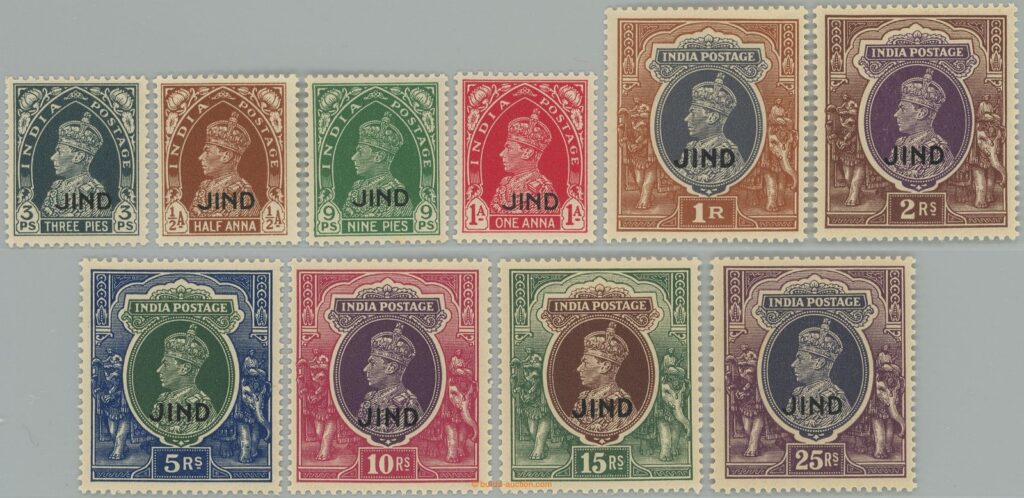
| JIND alone on the 1937 stamps, 1942–1943 | 3, 9 pies; ½, 1 anna; 1, 2, 5, 10, 15, 25 rupees | SG 127–136; StampWorld 117–126 |
| Later low-value designs, JIND, 1942–1943 | 3, 9 pies; ½, 1, 1¼, 1½, 2, 3, 3½, 4, 6, 8, 12 annas | StampWorld 127–139 |
The official stamps
The officials follow the same order. Under Queen Victoria, SERVICE was added to the curved and JEEND groups in half, one and two annas (StampWorld Service 1–6), then to the JHIND STATE stamps in half, one, two, four and eight annas and one rupee (Service 7–15, with the half anna’s colour change of 1902). The Edward VII officials, three pies to one rupee, are Service 16–24. George V officials on single-star paper, three pies to five rupees, are Service 25–35; on multiple-star paper, three pies to ten rupees, Service 36–54.[1][127]
Under George VI, JIND STATE SERVICE on ordinary stamps (half anna, nine pies, one anna and one, two, five and ten rupees) is SG O66–O72, StampWorld Service 55–61. The low values on Indian SERVICE stamps, three pies to eight annas with two half-anna colours, are Service 62–71, and the four JIND SERVICE rupees SG O83–O86 (Scott O72–O75), StampWorld Service 72–75; the whole later family is SG O73–O86.[17][40][34]
Stationery
None of Jind’s postcards and envelopes has a settled Jind catalogue number in the research. They are best cited by the report that records them: the Philatelic Record of 1885 (vol. VII, pp. 143 and 190) and May 1887 (p. 62) for the early convention items, Grosvenor lot 789 for the 1902 Toungoo card, and Gledhill’s articles of June, September and December 1966 and March 1967 for the George V and George VI cards. They are set out in the stationery chapter.[100][87][73][57][58][59][60]
Images still wanted
Of the 225 entries in the research checklist, 119 have a design-and-denomination image, and none of the 22 stationery entries is illustrated. Pictures of the Edward VII stamps, the early George V setting, the nine-pies surcharge, the Queen Victoria, Edward VII and George V officials, and any of the stationery would fill the largest gaps.
Sources
- [1] C. Stewart-Wilson, British Indian Adhesive Stamps Surcharged for Native States, Part II: Jhind, Nabha, Patiala, Calcutta: Philatelic Society of India, 1898, Jhind chapter, printing lists and addenda.
- [4] StampWorld online catalogue, Jind, ordinary postage: Edward VII and George V groups (catalogue group dates).
- [6] William E. Steiner, India—Convention States, album pages, pp. 26–37.
- [14] Christoph Gärtner, 17th auction, 7 March 2011, India and Indian States.
- [15] L. E. Dawson, “Indian Feudatory States—IV: Jind”, The Philatelist, July 1965, pp.222–225.
- [17] Burda Auction, Public Auction 74, Jind ordinary and official sets, objects 247408, 251321 and 247409.
- [18] Christoph Gärtner, 50th auction, Asia catalogue, 21 June 2021, lots 6826, 6828, 6830 and 6832; photographs printed p.51, descriptions printed p.188.
- [23] Halsey Stamp Co., The American Standard Catalogue of the Postal Issues of the World, 1896, p. 129, Jhind local issues, order nos. 10, 12 and 18.
- [24] E. B. Evans, “The Stamps of Some of the Native States of India—Jhind”, Stanley Gibbons Monthly Journal, December 1903, January and March 1904, pp. 116–119, 146–149 and 192–195.
- [31] Rowland Hill Stamps, Jind offer 2071, SG 64 grey three-pies.
- [33] StampWorld Jind, ordinary postage page 2, George V and George VI issue tables.
- [34] StampWorld, Jind, Service stamps, page 2, George VI groups, rows 72–75 headed 1945, 18 September.
- [40] Daniel F. Kelleher, sale 695, 29 November 2016, p. 49, lot 2292, 1942 JIND SERVICE set, SG O83–O86 and Scott O72–O75.
- [57] A. C. Gledhill, “Postal Cards of India (and the Indian Convention States)”, The Philatelist, June 1966, pp. 248–250.
- [58] A. C. Gledhill, “More about the K.G.V. ½-Anna Postal Cards of India and the Indian Convention States”, The Philatelist, September 1966, pp. 360–362.
- [59] A. C. Gledhill, “The K.G.VI 9 pies Postal Cards of India and the Indian Convention States”, The Philatelist, December 1966, pp. 87–89.
- [60] A. C. Gledhill, “The last of the K.G. VI Postal Cards of India and the Indian Convention States”, The Philatelist, March 1967, pp. 173–174.
- [67] Christoph Gärtner, auction 17, Indian States, lots 1154–1155 and 1158.
- [71] David Feldman, 2021 autumn sale, lot 51299, Jind eight-annas JEIND, SG 28a, ex Sturton.
- [72] Grosvenor, sale 126, lot 2866, Jind red-overprinted one-rupee JEIND, SG 16a.
- [73] Grosvenor, sale 143, lot 789, 1902 quarter-anna Jind postcard to Toungoo.
- [84] Stanley Gibbons Auctions, sale 5933, lot 573, SG 79 on registered cover to Allahabad.
- [87] The Philatelic Record, vol. IX, no. 100, May 1887, p. 62, Jhind stationery and black overprint.
- [88] L. W. Durbin, Descriptive Catalogue of the Postage Stamps and Stamped Envelopes of All Nations, 15th ed., p. 65, Jhind.
- [90] David Feldman, lot 70376, original stock-page scans, pp. 3–4, numbered two-anna and eight-annas groups.
- [100] The Philatelic Record, vol. VII, April 1885, no. 75, p. 54, Jhind notice attributed to G. J. Hynes. Compare May 1885, p. 74.
- [103] StampWorld, Jind postage 1885–1889, first ordinary group, rows 1–6, dated 1 July 1885.
- [127] D. B. Armstrong, Twentieth Century Colonials, Jhind, Gibbons Stamp Weekly.
- StampWorld Jind, ordinary postage page 3, JIND overprints on George VI.
- StampWorld Jind, Service stamps page 1, Queen Victoria through George V.
Notes 0
Add what you know: a cover or stamp in your collection, a date or source, a correction or a question.
No notes yet.
Sign in to add a note.
Notes show straight away. Keep them kind and about the article; anyone can report one that isn't. House rules
